The transflective LCD is a hybrid display technology designed to deliver clear visibility in both bright outdoor environments and low-light indoor conditions. It combines two optical principles—reflection and transmission—into a single screen structure, allowing it to adapt dynamically to surrounding lighting conditions. Unlike traditional LCDs that rely entirely on a backlight to produce visible images, this type of display can use ambient light to enhance readability while still maintaining backlight support when needed. Because of this dual-function design, it is widely used in devices that require reliable performance across changing environments, such as industrial instruments, transportation systems, and portable electronics. Understanding how a transflective LCD works requires looking at its structure, light behavior, and real-world performance advantages.
Basic Structure and Operating Principle
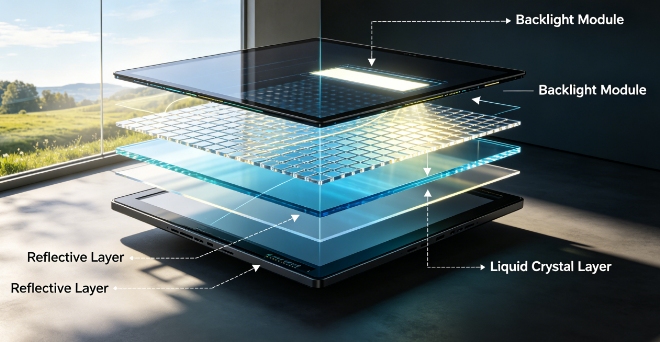
The core concept behind a transflective LCD lies in its special layer structure, which allows it to both reflect external light and transmit internal backlight.
- Dual-mode light layer design: The display includes a partially reflective layer that reflects ambient light to the viewer while still allowing backlight to pass through.
- Liquid crystal modulation system: Like all LCDs, it uses liquid crystal molecules to control light passage and create images.
- Backlight integration: A built-in backlight ensures visibility in dark environments where external light is insufficient.
- Pixel-based light control: Each pixel adjusts light transmission to form sharp images with improved contrast under varying lighting conditions.
Given that outdoor equipment often relies on battery systems or requires continuous operation, these energy-saving features make transflective LCDs particularly practical.
How It Uses Ambient Light and Backlight
One of the most important features of this technology is its ability to intelligently balance natural light and artificial backlighting.
Key working mechanisms include:
- Bright environment operation
In strong sunlight, the reflective layer becomes dominant, bouncing external light back to the user and reducing the need for backlight power. - Low-light operation
When ambient light is insufficient, the backlight activates to ensure the screen remains readable. - Adaptive light balancing
The display continuously adjusts the ratio between reflection and transmission depending on lighting conditions. - Energy optimization behavior
By utilizing ambient light when available, the system reduces overall power consumption.
This adaptive lighting system is what makes the transflective LCD highly efficient and suitable for outdoor use.
Key Components That Enable Its Function
The performance of a transflective LCD depends on the collaborative operation of multiple meticulously designed components.
- Reflective layer material: This semi-mirrored layer reflects external light while still allowing partial light transmission.
- Polarizer films: These layers control light direction and help improve image clarity and contrast.
- Liquid crystal layer: It regulates how much light passes through each pixel based on electrical signals.
- Backlight module: Provides illumination when ambient light is not sufficient for visibility.
Each component plays a specific role in ensuring the display remains readable under diverse lighting conditions, making the system highly versatile.
Advantages in Real-World Applications
The unique working principle of this display technology provides several practical benefits across different industries.
- Improved outdoor visibility: It remains readable under direct sunlight without requiring maximum backlight intensity.
- Energy efficiency: Reduced dependence on backlighting helps extend battery life in portable devices.
- Versatile usage environments: Suitable for both indoor and outdoor applications without switching display modes.
- Enhanced durability in field conditions: Often used in industrial, military, and transportation systems where lighting cannot be controlled.
These advantages make the transflective LCD a preferred solution in applications that demand both clarity and efficiency.
Limitations and Design Trade-offs
Although highly effective, this technology also comes with certain limitations that affect its usage in some scenarios.
- Lower color saturation compared to premium displays: The reflective layer can slightly reduce color vibrancy.
- Higher production complexity: Manufacturing requires precise layering, which increases cost.
- Performance variability in mixed lighting: Rapid changes between lighting conditions may affect contrast stability.
- Not always superior indoors: In fully controlled indoor lighting, traditional LCDs may offer similar or better performance at a lower cost.
These trade-offs mean that while the transflective LCD is highly functional, it is not universally the best option for every application.
Conclusion
The transflective LCD is a smart hybrid display technology that combines reflection and transmission to deliver clear visibility in both bright and dark environments. By using ambient light when available and switching to backlight support when necessary, it achieves a balance between readability and energy efficiency. Its unique structure and adaptive operation make it especially useful in outdoor, industrial, and portable applications where lighting conditions are unpredictable. Despite certain limitations regarding color reproduction and manufacturing complexity, its advantages in terms of versatility and energy efficiency nonetheless make it a highly valuable solution within the field of modern display technology.
0