In modern communication systems, network reliability has become a key requirement for homes, businesses, and industrial applications. As digital services continue to expand, traditional copper wiring is increasingly unable to meet the demand for high-speed, stable, and long-distance data transmission. This is where fiber optic drop cable plays a crucial role. Compared with conventional wiring solutions, it offers superior performance in speed, durability, and signal stability. Understanding why fiber optic drop cable is more reliable helps explain its rapid adoption in FTTH networks and modern broadband infrastructure.
Superior Signal Transmission Performance
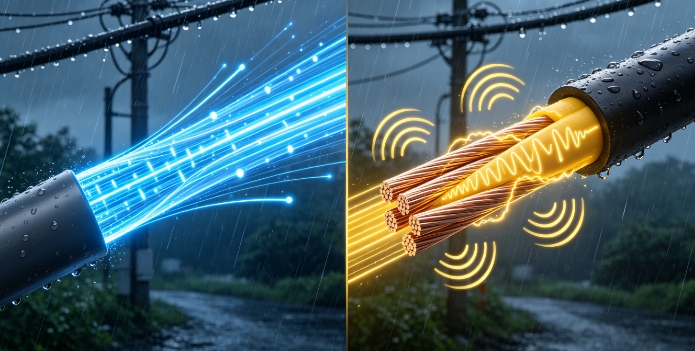
One of the main reasons fiber optic drop cable is considered more reliable is its advanced signal transmission capability compared to traditional copper wiring.
- Light-based transmission instead of electrical signals: Fiber optic cables transmit data using light pulses, which significantly reduces resistance and signal degradation over long distances.
- Minimal signal attenuation: Unlike copper cables that lose signal strength over distance, fiber optic drop cable maintains strong and stable performance even in extended network layouts.
- High bandwidth capacity: It supports significantly higher data transmission rates, making it suitable for high-speed internet, HD streaming, and cloud-based applications.
- Resistance to electromagnetic interference: Fiber optics is immune to EMI and radio frequency interference, ensuring cleaner and more stable signal delivery in complex environments.
These advantages make fiber-based systems far more stable than traditional wiring solutions.
Strong Environmental Resistance and Durability
Another key factor in the reliability of fiber optic drop cable is its ability to withstand harsh environmental conditions.
- Weather resistance in outdoor applications: Fiber optic cables are designed to handle rain, humidity, and temperature fluctuations without affecting performance.
- Corrosion-free structure: Unlike metal-based copper wires, fiber materials do not rust or corrode, extending their operational lifespan.
- Enhanced protective layering: Many fiber optic drop cable designs include reinforced jackets that protect against physical damage, such as crushing or bending.
- UV and chemical resistance: Outdoor-grade cables are often resistant to ultraviolet exposure and common environmental chemicals, making them suitable for long-term installation.
This durability ensures stable network performance even in challenging conditions.
Lower Maintenance Requirements and Long-Term Stability
Fiber optic systems are widely preferred because they require less maintenance compared to traditional wiring.
- Reduced failure rates: The structural stability of fiber optic drop cable minimizes the risk of frequent breakdowns or signal interruptions.
- Less physical wear over time: Since no electrical current flows through metal conductors, there is less heat generation and material fatigue.
- Stable long-term performance: Once properly installed, fiber systems can operate efficiently for many years without significant degradation.
- Fewer repair interventions needed: Network operators spend less time troubleshooting compared to copper-based systems.
This low-maintenance nature reduces operational costs and increases overall reliability.
Improved Safety and Interference Protection
Safety and interference resistance are also important reasons why fiber optic drop cable is more reliable than traditional wiring.
- No electrical conductivity: Fiber optics does not carry electrical current, eliminating risks of electric shock or short circuits.
- Immunity to electromagnetic noise: In industrial environments with heavy machinery, fiber cables maintain stable transmission without external disruption.
- Reduced fire risk: Because they do not generate heat like copper wires, fiber optic systems are generally safer in dense installations.
- Secure data transmission: Fiber optic signals are more difficult to tap or intercept, improving communication security.
These safety benefits make fiber optic systems ideal for both residential and enterprise networks.
Higher Scalability and Future-Ready Design
One of the most important advantages of fiber optic drop cable is its ability to support future technological expansion.
- Supports increasing bandwidth demands: As internet usage grows, fiber infrastructure can easily handle higher data loads without major upgrades.
- Compatible with modern FTTH systems: Fiber is the backbone of fiber-to-the-home networks, enabling ultra-fast broadband access.
- Flexible deployment options: It can be used in urban, suburban, and rural environments with adaptable installation methods.
- Long-term infrastructure investment: Fiber networks are designed to support future technologies such as 5G, smart homes, and IoT systems.
This scalability ensures long-term value and reduces the need for frequent infrastructure replacement.
Conclusion
In conclusion, fiber optic drop cable is more reliable than traditional wiring solutions due to its superior signal transmission, strong environmental resistance, low maintenance requirements, enhanced safety features, and future-ready scalability. Unlike copper-based systems, it delivers stable, high-speed, and interference-free performance over long distances, making it the preferred choice for modern communication networks. As digital demand continues to grow, fiber optic technology will remain a foundational solution for building efficient, reliable, and future-proof network infrastructure.
0