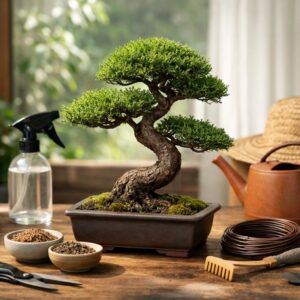
The defining feature of an S-shaped bonsai tree is its rhythmically curved trunk. This S-shaped form is not random or natural growth, but the result of long-term pruning, wiring, and environmental control. Unlike ordinary potted plants, the goal of caring for an S-shaped bonsai tree is not rapid growth, but slow, stable development with balanced proportions and a clearly defined structure. If long-term care becomes inconsistent or careless, even a well-trained bonsai can gradually lose its shape due to uncontrolled branch growth, root imbalance, or uneven light exposure. Therefore, caring for an S-shaped bonsai tree is a systematic, detail-oriented, and long-term process.
Light Requirements
Light conditions have a direct and lasting impact on the overall structure of an S-shaped bonsai tree, influencing branch direction, internode length, and the clarity of the S-shaped trunk line.
- Light duration: Providing 4–6 hours of stable, indirect light each day helps control excessive elongation, shortens internodes, and encourages compact foliage growth, resulting in a more refined overall structure.
- Placement location: When grown indoors, the bonsai should be kept in a fixed position near a south- or east-facing window to maintain consistent light direction, as frequent repositioning can cause uneven growth and distort the S-shaped form.
- Important notes: During summer, strong midday sunlight can scorch leaves, cause moisture loss, and weaken branch health, so partial shading or distance adjustment is recommended.
Long-term insufficient lighting can cause branches to stretch and lean toward the light source, gradually deforming the S-shaped trunk and reducing the bonsai’s ornamental value.
Watering Tips
Watering is one of the most critical and error-prone aspects of caring for an S-shaped bonsai tree, especially for beginners.
- Watering principle: Always follow the “water when dry” rule by checking soil color and surface moisture rather than watering on a fixed schedule.
- Watering method: Water slowly and evenly until moisture penetrates the entire soil mass, ensuring that both surface and deeper roots receive adequate hydration.
- Risk warning: Consistently waterlogged soil leads to oxygen deprivation in the root zone, which may initially appear subtle but can eventually cause yellowing leaves, leaf drop, and growth stagnation.
- Summer adjustment: In hot weather, water evaporation increases, so watering frequency may be increased, provided the soil drains well and airflow is sufficient.
- Winter adjustment: As growth slows in colder temperatures, water requirements drop significantly, and slightly drier soil conditions help prevent root rot during dormancy.
Pruning and Shaping
Pruning is essential not only for aesthetics but also for maintaining the long-term structural stability of an S-shaped bonsai tree.
- Pruning focus: Control branch length, density, and direction by removing leggy, crossing, or shape-disrupting branches to preserve the rhythm of the S-shaped trunk.
- Pruning timing: During the growing season, light pruning helps manage growth speed, while structural pruning during dormancy strengthens the overall framework.
- Shaping support: When using aluminum or copper wire, apply it along the natural growth direction of branches and inspect regularly to prevent wire marks as branches thicken.
Consistent and thoughtful pruning allows the bonsai’s form to mature gradually rather than changing unpredictably year after year.
Fertilization
Fertilization for an S-shaped bonsai tree is meant to support health, not accelerate growth.
- Fertilizing period: Spring through summer is the primary feeding season because the S-shaped bonsai tree is in its most active growth phase during this time.
- Fertilizing frequency: Apply diluted liquid fertilizer every 2–4 weeks to provide steady nutrition without overstimulating growth.
- Seasonal control: Gradually reduce fertilization in autumn to encourage branch hardening, and stop completely during winter dormancy.
Soil and Repotting
Soil quality directly affects root longevity and nutrient absorption in an S-shaped bonsai tree.
- Soil requirements: Use loose, well-aerated, fast-draining bonsai soil to prevent compaction and root suffocation.
- Repotting cycle: Typically every 1–2 years, with older or slower-growing trees repotted less frequently.
- Repotting process: Trim aged, circling, or damaged roots during repotting to stimulate fresh root growth and improve absorption efficiency.
Repotting is not just soil replacement, but an essential opportunity to restructure and rejuvenate the root system.
Common Mistakes and Important Notes
Most problems with an S-shaped bonsai tree develop gradually due to long-term neglect rather than a single mistake.
- Common mistake: Overwatering, which keeps roots in a constantly oxygen-poor environment.
- Environmental issue: Insufficient light or poor air circulation, leading to leggy growth and higher disease risk.
- Maintenance neglect: Infrequent pruning, causing the bonsai to lose its defined S-shaped silhouette.
Regular observation and small adjustments are the most effective ways to prevent serious issues.
Conclusion
Caring for an S-shaped bonsai tree is a long-term commitment that requires patience, consistency, and close attention to detail. Unlike ordinary potted plants, an S-shaped bonsai tree responds slowly to care. Meaning that both good and bad practices accumulate over time. By maintaining proper light exposure, well-controlled watering habits, regular pruning routines, balanced fertilization schedules, and appropriate soil management. An S-shaped bonsai tree can maintain strong vitality, stable growth, and a clearly defined S-shaped structure for many years.
For bonsai enthusiasts who value structure, balance, and artistic expression, the S-shaped bonsai tree represents more than simple cultivation. It is a living work of art that reflects the grower’s patience, observation, and long-term dedication. Gradually gains character and beauty as it matures over time.
0