As modern communication networks continue to evolve, businesses increasingly require tailored connectivity solutions to meet specific performance, environmental, and installation demands. This is where customized fiber solutions come into play. Unlike standard cables, a custom design allows for adjustments in fiber type, structure, length, and protective features. Naturally, many buyers ask: ” How much does a custom fiber optic cable cost? The answer varies widely depending on technical specifications and production requirements. When sourcing from custom fiber optic cable manufacturers, understanding the key cost drivers can help you make better purchasing decisions and avoid unnecessary expenses.
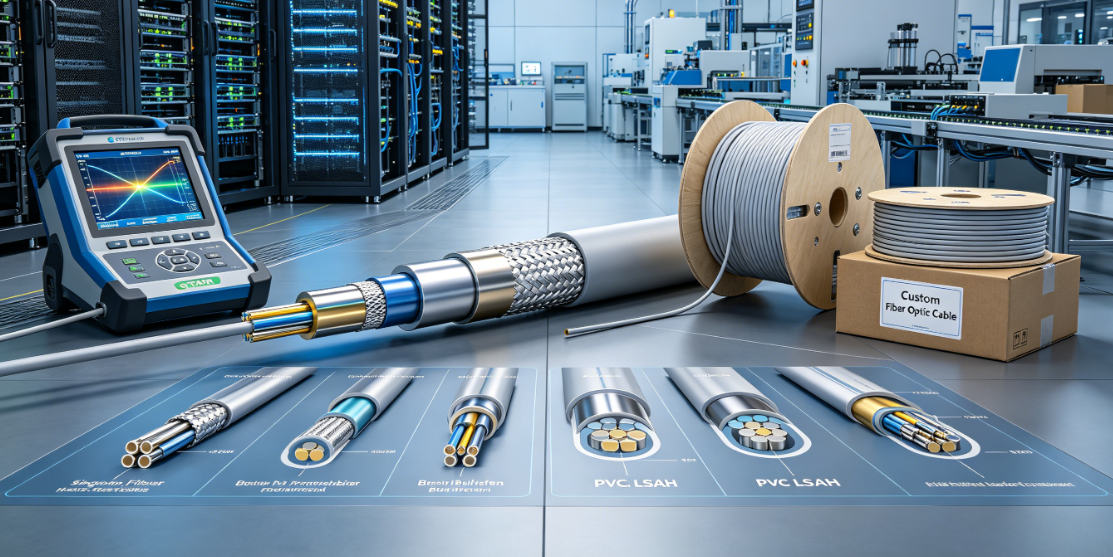
Design Complexity and Material Selection
The design of a custom fiber optic cable is one of the most important factors influencing its cost. More complex designs require additional materials and manufacturing processes.
- Fiber type and transmission requirements
Single-mode fibers are generally more expensive due to their ability to support long-distance, high-speed data transmission. Multi-mode fibers are more affordable but limited in range, making them suitable for shorter connections. - Cable structure and layering
Customized designs may include additional layers such as water-blocking gel, armor, or multiple strength members. Each added layer increases both material costs and production complexity. - Protective jacket materials
Special outer coatings like LSZH, TPU, or UV-resistant materials can significantly raise costs but provide better performance in specific environments. - Connector and termination options
Pre-terminated cables with connectors such as LC, SC, or MPO require precision assembly, adding labor and equipment costs to the final price.
Production Volume and Customization Level
The degree of customization and order size directly impact the overall cost structure.
- Low-volume production costs more per unit
Small batch orders require setup time and specialized production adjustments, resulting in higher unit pricing compared to mass production. - High customization increases manufacturing effort
Unique specifications such as non-standard lengths, special coatings, or hybrid cable designs require more engineering input and testing. - Economies of scale in bulk orders
Larger orders significantly reduce per-unit cost because production lines can operate more efficiently, spreading fixed costs across more units. - Lead time and urgency factors
Rush orders often increase costs due to expedited production schedules and priority resource allocation.
Application Environment and Performance Requirements
The intended usage environment plays a major role in determining cable cost.
- Indoor vs outdoor deployment
Indoor cables are typically simpler and cheaper, while outdoor cables require waterproofing, UV resistance, and temperature tolerance, increasing costs. - Harsh environment applications
Industrial, military, or underground installations may require armored or reinforced designs to resist physical damage and environmental stress. - Bending and flexibility requirements
Applications with tight routing paths require bend-insensitive fibers, which are more expensive but reduce signal loss. - Signal performance expectations
Higher performance standards, such as low attenuation and high bandwidth capacity, often require premium materials and stricter quality control.
Additional Cost Factors in Custom Fiber Solutions
Beyond materials and design, several secondary factors also influence pricing.
- Testing and quality assurance
Custom cables often undergo rigorous testing to meet industry standards, which adds to production costs but ensures reliability. - Packaging and logistics
Specialized packaging for long or delicate cables can increase shipping costs, especially for international orders. - Certification and compliance
Products that meet international certifications (such as ISO or telecom standards) may cost more due to additional testing and documentation. - Supplier expertise and reputation
Established custom fiber optic cable manufacturers typically charge higher prices, but they offer better consistency, technical support, and long-term reliability.
How to Control Costs Without Compromising Quality
While custom solutions can be expensive, there are strategies to optimize cost efficiency.
- Clearly define technical requirements
Avoid over-specifying features that are not necessary for your application, as this can unnecessarily increase costs. - Balance performance and budget
Choose materials and designs that meet your needs without exceeding them, ensuring cost-effective performance. - Work with experienced manufacturers early
Collaborating with reliable custom fiber optic cable manufacturers during the design phase can help identify cost-saving opportunities. - Plan for long-term use
Investing slightly more upfront in higher-quality cables can reduce maintenance, replacement, and downtime costs over time.
Conclusion
The cost of a custom fiber optic cable depends on multiple factors, including design complexity, material selection, production volume, environmental requirements, and additional services such as testing and certification. Prices can vary significantly from relatively affordable customized solutions to highly specialized cables designed for demanding environments. By understanding these cost drivers and working closely with experienced suppliers, buyers can achieve the right balance between performance and budget. Ultimately, a well-chosen custom solution ensures reliable connectivity, long-term durability, and better overall value for modern communication networks.
0