As manufacturing companies continue to face rising labor expenses, energy consumption pressures, and increasing demands for precision, many are turning to fiber laser equipment as a cost-effective production solution. This advanced technology is widely used in metal cutting, welding, marking, and precision processing across industries such as automotive, electronics, machinery, and aerospace. The key question is whether fiber laser equipment can truly reduce manufacturing costs while maintaining high productivity and quality standards. In many cases, the answer is yes—thanks to its energy efficiency, automation compatibility, low maintenance requirements, and high material utilization rate. However, the actual cost-saving effect depends on how the system is applied within the production workflow.
Energy Efficiency and Reduced Operating Consumption
One of the most direct ways fiber laser equipment helps reduce manufacturing costs is through significantly lower energy usage compared to traditional processing methods.
- Higher electrical-to-laser conversion efficiency:
Fiber laser systems convert a larger percentage of electrical energy into usable laser power, reducing wasted energy during operation. - Lower cooling requirements:
Compared with CO2 laser systems, fiber lasers generate less excess heat, which reduces the need for intensive cooling systems and lowers electricity consumption. - Stable long-term operation:
Efficient energy usage allows machines to run continuously with fewer fluctuations, reducing energy spikes during production cycles. - Reduced auxiliary system load:
Support components such as air compressors and ventilation systems operate less intensively, further lowering overall factory energy costs.
These advantages make fiber laser technology especially attractive for factories aiming to optimize long-term operational expenses.
Reduced Maintenance and Labor Costs
Another major cost-saving advantage of fiber laser equipment is its low maintenance requirement and reduced dependence on manual labor.
① Solid-state laser structure reliability
Unlike traditional laser systems with complex optical paths, fiber lasers have fewer moving parts, resulting in fewer mechanical failures.
② Minimal consumable replacement needs
Many components, such as mirrors and gas systems used in older technologies, are not required, significantly reducing ongoing maintenance costs.
③ Long service life of core components
Laser sources can operate for tens of thousands of hours, reducing replacement frequency and downtime-related losses.
④ Lower operator workload
Automation and smart control systems reduce the need for constant manual adjustments, allowing fewer operators to manage more machines.
Together, these factors help manufacturers significantly reduce both direct maintenance expenses and indirect labor costs.
Material Efficiency and Waste Reduction
A less obvious but highly important cost-saving factor of fiber laser equipment is its ability to improve material utilization and minimize waste.
- High precision cutting reduces scrap rates:
Narrow laser beams allow for accurate cutting paths, reducing unnecessary material loss during production. - Optimized nesting software integration:
Advanced systems arrange cutting layouts efficiently to maximize material usage from each sheet or workpiece. - Reduced rework and defect rates:
High processing accuracy minimizes errors, which lowers the cost of reprocessing defective parts. - Cleaner edges eliminate secondary processing:
In many cases, parts require little or no post-processing, saving additional labor and equipment time.
This level of efficiency directly reduces raw material costs, which often represent a major portion of manufacturing expenses.
Automation and Productivity-Driven Cost Savings
In modern production environments, fiber laser equipment plays a key role in enabling automation, which further reduces operational costs.
Integrated smart manufacturing systems
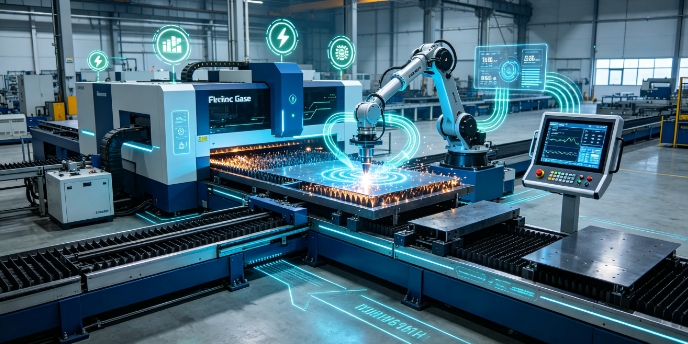
Laser machines can connect with robotic arms, conveyor belts, and digital control systems to create fully automated production lines.
Faster production cycles
High-speed processing increases output per hour, allowing manufacturers to produce more units without increasing labor or equipment costs.
Reduced human error
Automation minimizes inconsistencies caused by manual operation, leading to fewer defective products and lower waste rates.
Real-time monitoring and predictive maintenance
Smart systems detect issues early, preventing unexpected downtime and expensive repairs.
By improving productivity while reducing dependency on manual labor, automation significantly lowers per-unit production costs.
Initial Investment vs Long-Term Cost Benefits
Although fiber laser equipment provides strong cost-saving advantages, manufacturers must also consider the initial investment and long-term return.
- Higher upfront purchase cost:
Advanced laser systems require significant capital investment compared to traditional machinery. - Infrastructure upgrade requirements:
Some facilities may need electrical, cooling, or layout modifications before installation. - Training and system adaptation:
Operators may require training to fully utilize automation and software features. - Long-term ROI advantages:
Despite initial costs, reduced energy usage, maintenance savings, and higher productivity often lead to strong long-term return on investment.
When evaluated over time, the total cost of ownership is typically lower than that of conventional manufacturing systems.
Conclusion
In conclusion, fiber laser equipment can significantly reduce manufacturing costs through improved energy efficiency, lower maintenance requirements, better material utilization, and enhanced automation capabilities. While the initial investment may be relatively high, the long-term operational savings and productivity gains often outweigh upfront expenses. As industries continue to adopt smart manufacturing technologies, fiber laser systems are becoming a key solution for companies seeking to optimize production efficiency and maintain competitive cost structures in modern industrial environments.
0