The Role of Fiber Faceplate in Fiber Access Systems
In modern fiber access networks, the Fiber Faceplate is commonly used as an indoor fiber termination interface and serves as a critical connection point between the incoming optical cable and fiber patch cords. It plays an essential role in the transition of optical signals from outdoor backbone networks to indoor user environments, especially in FTTH deployment scenarios.
The fiber faceplate integrates fiber splicing, fiber storage, and fiber connection management into one compact and protective enclosure. This integrated design helps organize fiber routing effectively, prevents fiber exposure, and minimizes risks caused by excessive bending, pulling, or external mechanical stress, thereby improving the stability and service life of the fiber link. With its compact structure, easy installation, and reliable protection performance, the fiber faceplate is widely applied in various FTTH and indoor fiber cabling environments to support stable and high-speed optical network access.
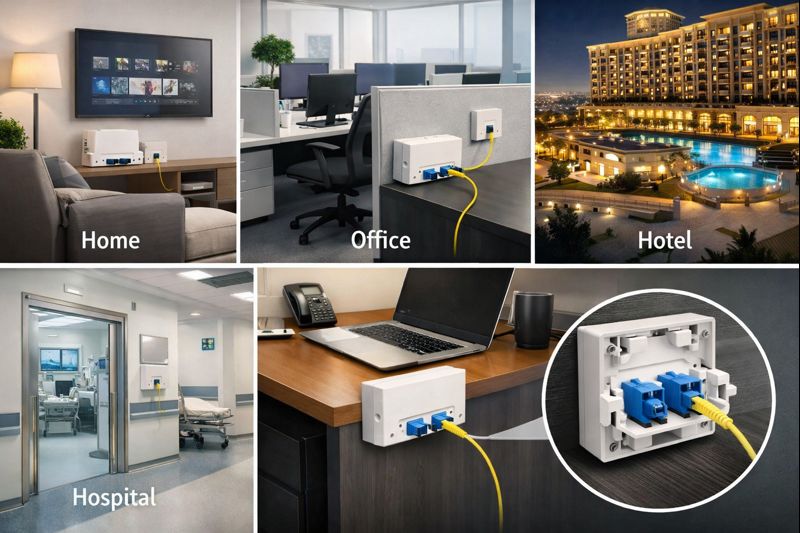
Main Application Scenarios of Fiber Faceplate
1. FTTH (Fiber to the Home) Residential Fiber Access
In FTTH projects, the fiber faceplate is typically installed on residential walls, near weak current boxes, or inside information panels as the termination point of the incoming fiber cable. Its main functions include:
- Connecting the incoming optical cable with indoor fiber patch cords to ensure smooth signal transition.
- Providing a standardized and stable fiber interface for ONT or home gateway devices.
- Organizing and protecting indoor fiber cables to maintain a clean and orderly installation.
Fiber faceplates supporting 8 ports or 16 ports can meet multi-room and multi-service access requirements while allowing sufficient capacity for future bandwidth upgrades and smart home applications.
2. FTTO (Fiber to the Office) Office Environment Applications
In office buildings and commercial complexes, fiber faceplates are widely used in FTTO network architectures as indoor fiber termination points. They are mainly applied in:
- Wall-mounted or desk-side fiber access points for daily office network connections.
- Edge access locations of equipment rooms or data centers. Enterprise high-speed optical cabling systems supporting data, voice, and video services.
Thanks to compatibility with SC, FC, and LC adapters, fiber faceplates can flexibly adapt to different fiber equipment and cabling standards, making network expansion, upgrading, or reconfiguration more efficient.
3. FTTD (Fiber to the Desk) Desktop-Level Fiber Deployment
In environments with high requirements for network bandwidth and stability—such as financial institutions, R&D centers, and educational laboratories—the fiber faceplate is a key component in FTTD architectures. It is mainly used to:
- Provide direct desktop-level fiber access for end-user devices.
- Support stable transmission of high-speed data, voice, and multimedia services.
- Reduce signal loss and electromagnetic interference associated with traditional copper cabling.
The internal large-diameter fiber winding structure ensures the minimum bending radius of optical fibers, effectively reducing attenuation and improving overall network performance and reliability.
4. Hotels, Apartments, and Smart Buildings
In hotels, serviced apartments, and smart building projects, fiber faceplates must meet both functional and aesthetic requirements. Their key advantages include:
- Compact design suitable for flush mounting or surface mounting.
- Durable ABS material with good mechanical strength.
- Dust-proof design with a protection level of IP45, suitable for long-term indoor operation.
These features make fiber faceplates an ideal solution for high-density room deployments and centralized indoor fiber cabling systems.
5. Hospitals, Schools, and Public Buildings
In public facilities where network stability and security are critical, fiber faceplates are commonly used for:
- Fiber access in hospital information systems and medical networks.
- Campus networks, laboratories, and educational facilities.
- Government buildings and public service network infrastructures.
The integrated fiber management design helps standardize fiber routing, reduce maintenance complexity, and minimize potential safety risks caused by exposed optical fibers, ensuring long-term stable operation of fiber networks in public environments.
Advantages of Fiber Faceplate Across Different Scenarios
Across all application scenarios, fiber faceplates demonstrate consistent technical and structural advantages, including:
- Support for multi-port fiber access to meet different network scale requirements.
- Easy installation and convenient maintenance.
- High compatibility with various fiber adapters.
- Effective fiber management and protection to reduce signal loss.
These advantages make the fiber faceplate an indispensable component in FTTH indoor fiber cabling systems.
Conclusion
With the continuous development of FTTH, FTTO, and FTTD networks, the application scope of Fiber Faceplate is expanding rapidly. Whether in residential, commercial, or public environments, fiber faceplates play a crucial role in the “last-meter” fiber connection of optical networks. Selecting a fiber faceplate suitable for specific application scenarios can significantly improve network stability, enhance user experience, and reduce long-term operation and maintenance costs.
0