MTP Trunk Cable is a high-density fiber optic cable terminated with an MTP/MPO connector. It does not transmit in a single channel, but rather bundles multiple optical fibers into a single line. It is designed for high-capacity data environments requiring high speed, neat cabling, and scalability.
Why MTP Trunk Cable Became A Popular Choice
The reason more companies choose MTP trunk cable is not trend-driven. It directly solves real cabling problems.Advantages include:
- High fiber capacity in small space:Multiple fibers in one connector increase port utilization, ideal for dense racks.
- Faster deployment and lower installation labor:Pre-terminated ends eliminate complex field work. Engineers connect both ends and start testing.
- Supports network upgrades easily:When networks evolve from 10G to 100G or beyond, the infrastructure does not need replacement. Only modules or harness cables may change.
- Neater cable management:Less cable volume improves airflow and reduces overheating risk.
- Long-term cost savings:Initial price may appear higher, but reduced labor and upgrade flexibility make it cost-effective in long-run operation.
Specifications To Consider Before Buying
Choosing an MTP trunk cable without understanding parameters often leads to mis-matching. The following factors should be reviewed before purchasing.
Fiber Count
- 12 or 24 fibers for standard backbone runs.
- 48, 72, 96 fibers for hyperscale systems.
- Higher counts reduce cable bundles and simplify management.
Fiber Mode
- OM3/OM4 multimode for short links and 40G/100G transmissions.
- OS2 single-mode for long distance or high-speed backbone.
Jacket Rating
- OFNP for plenum and high-safety areas.
- LSZH for low smoke and halogen-free environments.
- PVC commonly used in standard rooms.
Performance Grade
- Low-loss MTP connectors reduce signal loss.
- Check return loss and insertion loss values if network is ultra-high speed.
Understanding these factors prevents configuration mistakes and reduces re-wiring downtime.
Common Scenarios Where MTP Trunk Cable Performs Best
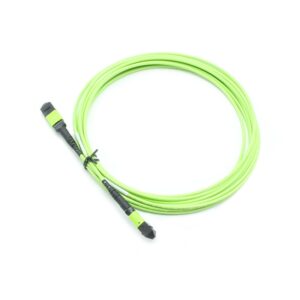
The MTP trunk cable is chosen most often in environments where space is limited, transmission speed is high, and upgrades are frequent.It performs well in:
- Data centers running cloud computing workloads.
- Large telecom rooms connecting core devices.
- GPU clusters used for AI training and high-performance computing.
- Storage and SAN networks handling large data flows.
- ISP backbone networks requiring stable, continuous data transfer.
- Enterprises building structured cabling with planned expansion.
These scenarios rely on strong backbone capacity. Using an MTP trunk cable provides clean routing and avoids chaotic patch cord bundles.
Installation And Usage Tips
Even a good cable performs poorly if handled incorrectly. During deployment of MTP trunk cable, technicians should follow these points:
- Plan topology and polarity before installation.
- Keep bend radius within recommended limits.
- Use cable managers for horizontal and vertical routing.
- Label both cable ends for quick maintenance.
- Clean MTP connector endfaces regularly.
- Conduct OTDR and link loss tests before going live.
- Avoid pulling cables with force that may stress internal fibers.
Following these practices increases operating stability and reduces future maintenance cost.
MTP Trunk Cable vs Traditional Fiber Cables
Traditional LC duplex patch cords work well for simple connections, but when devices increase from dozens to thousands, weaknesses become obvious: more cables are required, airflow becomes blocked, and upgrades take longer. The MTP trunk cable, carrying many fibers at once, replaces multiple duplex cords and reduces physical clutter. This means cleaner racks, easier cable tracking, and faster troubleshooting.
LC patch cords still have their place for short device-to-equipment connections. However, the MTP trunk cable is more suitable for backbone transmission and central routing, especially when speed and density increase.
Practical Recommendations For Different Buyers
To make purchasing easier, the following decision guide can help:
- New data center project → choose 24-fiber or 48-fiber MTP trunk cable for expansion room.
- Enterprise upgrading to higher speed → OM4 or OS2 low-loss MTP recommended.
- Systems requiring frequent re-deployment → combine trunk cables with cassettes for flexible port conversion.
- Small server rooms on limited budget → 12-fiber models provide enough capacity without waste.
- Cloud and telecom networks → consider 72-fiber or above for large cluster backbones.
- Choosing based on future needs avoids re-installation cost later.
Conclusion
As network workloads continue to grow, planning cabling with MTP trunk cable from the start brings smoother scaling, cleaner racks, less labor, and long-term cost efficiency.
0