A fiber pigtail is a short optical fiber cable with a connector pre-installed on one end and a bare fiber on the other. It acts as a bridge between optical fibers and devices, making it a vital part of network termination, splicing, and patching processes. Fiber pigtails are commonly used in telecommunications, data centers, and FTTH systems because they simplify fiber management while ensuring stable, low-loss connections.
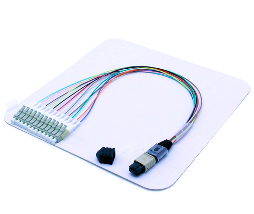
The Basic Structure of a Fiber Pigtail
A typical fiber pigtail includes three main components: the fiber core, protective coating, and outer jacket.
- The core carries light signals, while the cladding ensures total internal reflection. A buffer coating protects the fiber from physical damage.
- On the connectorized end, types like SC, LC, FC, and ST are used, depending on the application.
- These connectors ensure precise alignment and minimal signal loss when joined to another fiber or device.
How Fiber Pigtails Function in Optical Networks
The working principle of a fiber pigtail lies in its ability to connect optical fibers through fusion splicing. The bare end of the pigtail is spliced to the main cable, creating a permanent, low-loss connection. This splicing process helps integrate fibers into panels, switches, and transmission equipment without excessive bending or physical strain.
In essence, the fiber pigtail serves as a flexible termination point, enabling easier maintenance and upgrades in fiber-optic systems.
Key Advantages of Using Fiber Pigtails
- Low Insertion Loss – The high-quality connectors and precision splicing ensure minimal optical signal loss.
- Ease of Installation – Pre-terminated connectors save time and reduce installation errors.
- Flexibility – They enable modular upgrades without replacing entire fiber runs.
- Cost Efficiency – In long-term applications, fiber pigtails reduce maintenance and labor costs.
Because of these benefits, fiber pigtails are preferred in modern network infrastructures where reliability and performance are essential.
Common Types of Fiber Pigtails
There are two major classifications: single-mode and multi-mode.
- Single-mode fiber pigtails are used for long-distance transmission and high-speed communication, featuring a small core size (typically 9µm).
- Multi-mode fiber pigtails, with larger cores (50µm or 62.5µm), are ideal for shorter distances like within data centers.
Additionally, fiber pigtails can have simplex or duplex configurations. Simplex uses one fiber strand, while duplex uses two for bi-directional communication.
Applications Across Industries
Fiber pigtails are widely used in:
Telecommunication networks, where optical fibers are linked to transmission equipment.
Data centers provide efficient connections between switches and distribution panels.
Industrial automation supports reliable data transmission in control systems.
FTTH (Fiber to the Home) offers efficient network terminations for residential connections.
Their versatility makes them essential in any fiber optic installation that values both precision and performance.
Factors Affecting Performance
The performance of a fiber pigtail depends on several factors, such as connector quality, fiber alignment, splicing precision, and environmental conditions.
Improper handling during installation may cause microbending or fiber stress, leading to signal loss. Ensuring that connectors are clean and splices are performed accurately helps maintain optimal transmission efficiency.
Testing and Quality Assurance
Before deployment, each fiber pigtail must undergo insertion loss testing and return loss measurement. These tests confirm that the pigtail meets the required performance standards. Manufacturers often use OTDR (Optical Time-Domain Reflectometer) tools to detect any imperfections along the fiber.
Consistent testing ensures that the network maintains reliability and minimizes downtime due to optical failures.
Conclusion
A fiber pigtail may seem small, but it plays a crucial role in maintaining high-quality data transmission and simplifying network design. By ensuring low loss, easy splicing, and long-term durability, fiber pigtails remain one of the most reliable solutions for optical connectivity across industries.
0